short path distillation
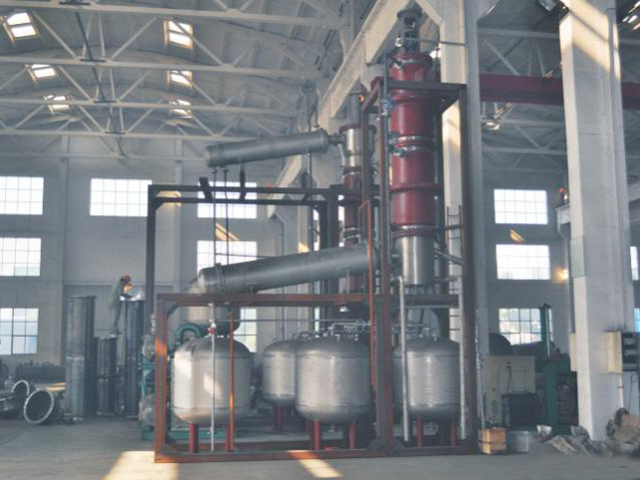
short path distillation/Basic principles of molecular distiller
Short path distillation is a method that operates in high vacuum (<10Pa) conditions, the molecules evaporated on the heating surface reach the condensation surface through the shortest possible distance for condensation, thereby achieving liquid-The distillation process of liquid separation. When the distance between the heating surface and the condensation surface is less than or equal to the mean free path of the evaporated molecules under the operating vacuum and temperature, the distillation process is also called molecular distillation. It has the characteristics of low distillation temperature, high distillation vacuum, short heating time, and high degree of separation.
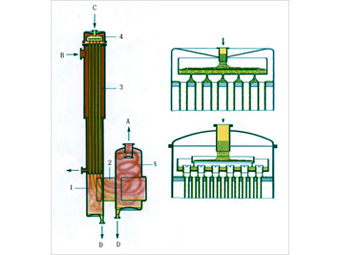
The material enters the short-path distiller from the upper flange cover, and is continuously and evenly distributed to the vertical cylinder heating surface through the distribution plate on the rotor. While the material falls by gravity, the rotating film scraping device forces a thin turbulent liquid film on the heating surface.
The distillation process is divided into the following steps:
1. The material forms a liquid film on the heating surface when it reaches the built-in condenser and condenses down. It is discharged through the outlet at the bottom of the evaporator. The heavy components enter the residue collection tank of the short-path distiller and are discharged from the outlet on the side.
2. The evaporated molecules condense on the condensation surface.
3. Collection and discharge of distillates and residues.
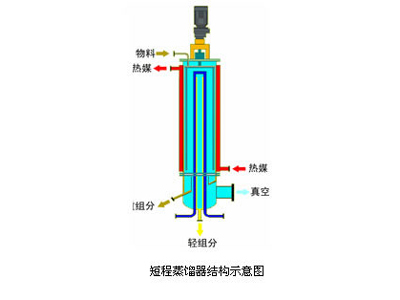
Performance characteristics
High vacuum degree and low distillation temperature; working vacuum:0.1Pa~10 Pa.
Large heat transfer coefficient and high evaporation efficiency: The rotating film scraping device scrapes the material into a uniform film on the inner surface of the evaporation cylinder, which reduces the thermal resistance. Under high vacuum, the easily evaporable substances are easily distilled and separated from the material; because the liquid film between the inner surface of the cylinder and the film scraper is in severe turbulence. In the dynamic state, the transfer of different components in the material and the heat transfer with the heating medium in the heating jacket are high; in addition, due to the high smoothness of the inner surface of the cylinder and the constant movement of the film scraper, the heating surface is not prone to coking and scaling, which also helps to increase the total heat transfer coefficient and improve evaporation efficiency.
Short heating time: The materials entering the short-range distiller are evenly distributed from the distribution plate to the vertical heating surface. Under the dual action of gravity and the film scraper, they spiral downward along the limited-length heating surface. The residence time in the evaporator is very short, generally a few seconds to tens of seconds (the average residence time is related to the length of the heating surface, the form of the film scraper, the characteristics of the material, film thickness and other parameters). also,DZSeries of short path stills“No blind spots”The design avoids the accumulation of materials on the distribution plate, heating surface and scraping film system, and reduces the thermal polymerization and thermal decomposition of heat-sensitive substances.
Structural features
1. Transmission and mechanical seal design ensure long-term smooth operation of the equipment
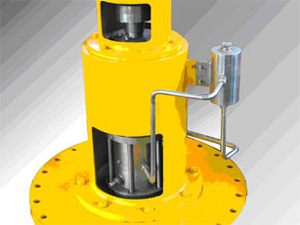
DZThe transmission device and mechanical seal of the series of short-path stills are designed and manufactured to ensure long-term stable operation of the equipment. The reduction ratio of the transmission device, the lubrication method of the mechanical seal (forced circulation lubrication, static lubrication) and the cooling method of the mechanical seal are determined according to the working conditions and material characteristics of the short-path still.
2. The evaporation cylinder is integrally processed and formed without intermediate flange connection.
The evaporation cylinder of the short-path distiller consists of an inner cylinder and a heating jacket.DZThe cylinders of the series of short-path stills are integrally processed and formed, and the evaporation cylinder has no intermediate flange connection. The integrally processed cylinder avoids leakage and material accumulation caused by flange connections, and avoids low-temperature zones on both sides of the flange, resulting in the evaporation surface not being effectively utilized. In addition, the integrally processed and formed cylinder can ensure the accuracy of the equipment and good film-forming effect.
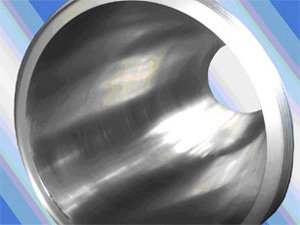
3. The inner surface of the cylinder has high smoothness and is not easy to stick to materials.
As the heating and evaporation surface of the short-path distiller, the inner surface of the cylinder has strict requirements for surface finish.DZAfter the inner surface of the barrel of the series of short-path distillers is rough-machined to meet the collective size requirements, it is finely ground to make the inner surface smooth.Ra0.8μm, which can make the inner surface less likely to stick to materials and scale, reduce material retention, and improve heat and mass transfer efficiency. According to the requirements of industries such as food and medicine, polishing technology can also be used to make its surface finishRa0.2μm.
4. Design of liquid distributor and anti-splash device to effectively ensure product quality
In order to improve the evaporation efficiency, the materials of the short-path distiller are continuously and evenly distributed on the vertical cylinder heating surface.DZThe liquid distributor of the series of short-path stills can not only distribute the materials evenly on the heating surface, but also prevent a small amount of materials from staying on the distributor for a long time, even for high-viscosity materials.
DZThe series of short-path stills are designed and manufactured to ensure long-term smooth operation of the scraping film device. Its excellent film-forming performance makes the evaporation process of materials gentle, without causing splashing and entrainment. In most cases, product requirements can be met even without splash-proof devices. When dealing with certain materials and product requirements,DZThe splash-proof device of the series of short-path stills can ensure product quality.
Scratching film form
A variety of film scraper forms are available, with a wide range of uses;
Inclined groove scraper type, roller type;
Adopt specialPTFEThe material working temperature can reach280℃;
Metal hinged fixed scraper.
Application scope
It can replace conventional falling film evaporators and be used for distillation, purification, concentration and decolorization of petrochemical and chemical products;
Suitable for distillation and refining of heat-sensitive and easily oxidized chemical industrial products;
It can also be used for distillation separation of high boiling point products.
Typical applications
Distillation and refining of polyunsaturated fatty acids (oleic acid, linolenic acid, fish oil fatty acid (ethyl ester)) and their derivatives;
Refining of monoglycerides;
Refining of dimer acid;
VE, Refining of phytosterols;
Distillation of liquid crystals;
Removal of monomers from polymers;
Refining of other heat-sensitive products.
Product selection
According to theoretical calculations and years of experience in the application and promotion of short-path distillation, the processing capacity of short-path distillation is directly related to the molecular weight of the raw material (product), material viscosity, operating conditions, and the effective heat exchange area of the evaporator.
Commonly used feed rates:100 kg / (m2 h),( 80 - 150 kg /(m2 h))
Small size: DZ-5Effective evaporation area0.05square;
Large specifications: DZ-3600Effective evaporation area36square;
Equipment material:SUS304,SUS316L,SAF2205and Hastelloy;
Working temperature:350℃.
Rising film evaporator
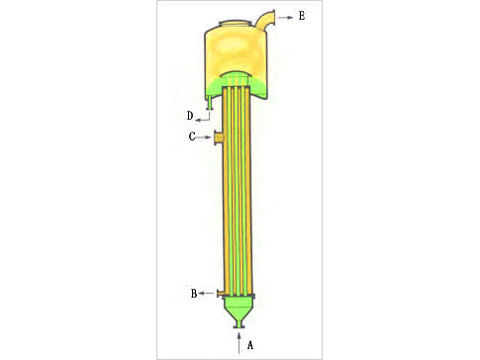
The rising film evaporator is also called a climbing film evaporator. It operates based on the siphon pump principle. According to the lift of the steam bubbles generated during the boiling process, the liquid and steam flow upward simultaneously. At the same time, the amount of steam generated increases, thus creating a flowing film on the tube wall, that is, the liquid moves upward.“climb”. The upward motion of the parallel flow has ribs that create a high degree of turbulence in the liquid.
This type of evaporator is characterized by a long heating tube (approx.5~7M), but the temperature difference between the heating chamber and the boiling chamber must also be large, otherwise, the energy of the steam flow is insufficient to transport the liquid and produce a climbing film.
A: Material import
B: Condensate outlet
C:Steam import
D:Concentrate outlet
E: Secondary steam outlet
Falling film evaporator
In a falling film evaporator, liquid and steam flow downward in parallel. The liquid to be concentrated is preheated to the boiling temperature. The uniform liquid film enters the heating tube through the liquid distribution device on the top of the evaporator, flows downward and partially evaporates at the boiling temperature. The gravity introduced by the downward movement is continuously strengthened by the parallel steam flow.
In falling film evaporators, adequate wetting of the liquid to the heating surface is important for trouble-free operation of the unit. If the heating surface is not sufficiently moistened, local dry walls and encrustation will occur. In the worst case, the heating tube will be completely blocked. In critical cases, the wetting rate increases with increasing or dividing evaporator efficiency, so the advantages of single-pass operation should be maintained. In this mode of operation, the contact time between liquid and heating surface is almost constant.
In addition to tube size, selection of the appropriate liquid distribution device is important to obtain wetting, both liquid distribution devices. Due to the low liquid volume and high flow rate in the heating tube, the product residence time is very short, so that heat-sensitive materials can be evaporated gently.